
Highlights from the Collection: Combat
Bronze Band
 The fortress of Sargon II at Khorsabad included a complex of temples, one of which was devoted to the sun god Shamash. This bronze band encircled one of a pair of cedar poles-possibly supports for divine emblems-that once flanked the doorway to this temple. The band was affixed to the pole by nails driven through the centers of the rosettes that decorate the three narrow bands framing the two main registers.
In the upper register, Sargon is shown grasping two massive bulls by the horns. This ancient motif, known as "the master of animals," was well established in Mesopotamian royal iconography and perhaps symbolized the dominance, vitality, and potency of the reigning monarch. To the left of the king and bulls is a large bird depicted in flight, to the right, facing the king and bulls, is an attendant wearing a kilt. In the lower register, only a fig tree and the tip of a plough are preserved.
Victorious Assyrian Soldiers
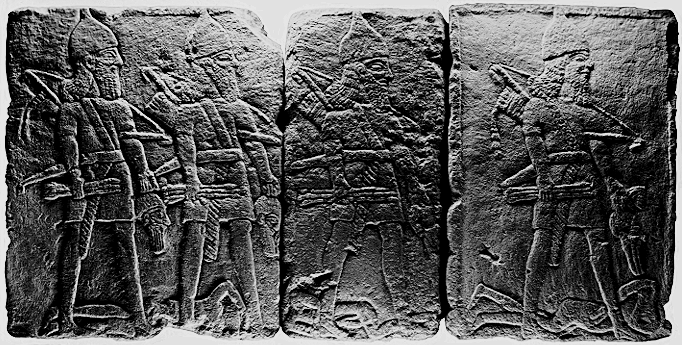 After they had conquered Tell Ta'yinat, the Assyrians carved these reliefs and used them to decorate a palace or public structure. The scene shows victorious Assyrian soldiers carrying the cut-off heads of their defeated enemies to a location where the number of those slain would be counted. Beneath the soldiers' feet lie the decapitated bodies. Each soldier wears a helmet, carries a bow and quiver over his shoulder, and holds three arrows in his right hand. At a later date, perhaps after the decline of Assyrian power, the reliefs were reused, face-down, as paving stones.
Cup Supported by Hero and Animals
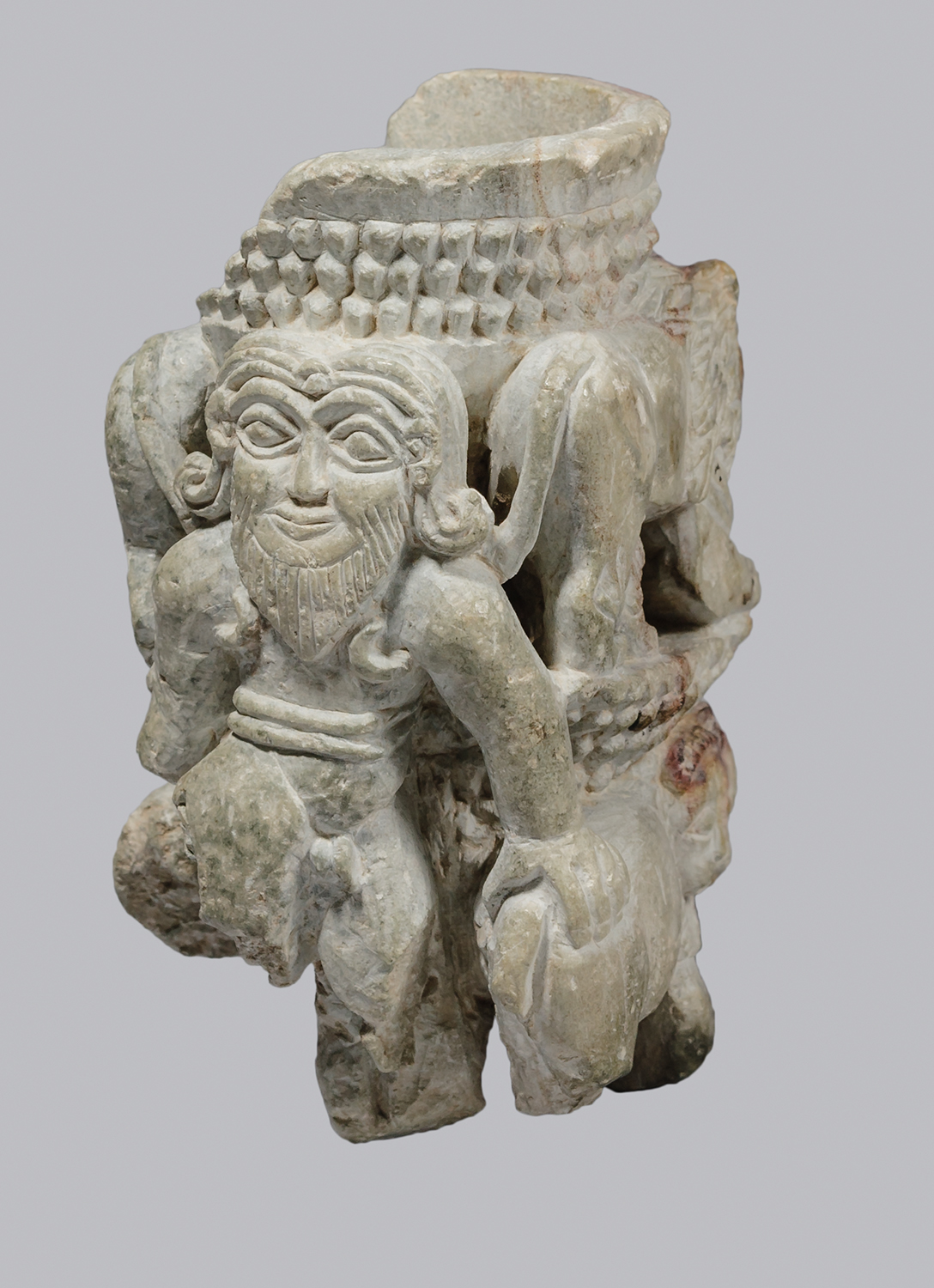 This elaborate vessel was discovered in the Shara Temple where it was probably used to place offerings before the god. The decoration of its openwork support shows a hero, naked except for a double-strand belt, grasping the rumps of two lions in his hands. The curling tails of two additional lions are tucked under his arms, and all four felines menace a bearded bull at the opposite end of the stand. Series of figures such as these, engaged in static combats, are common in ancient Mesopotamian art. Their exact meaning is unknown.
